
«elders», 2021-2022
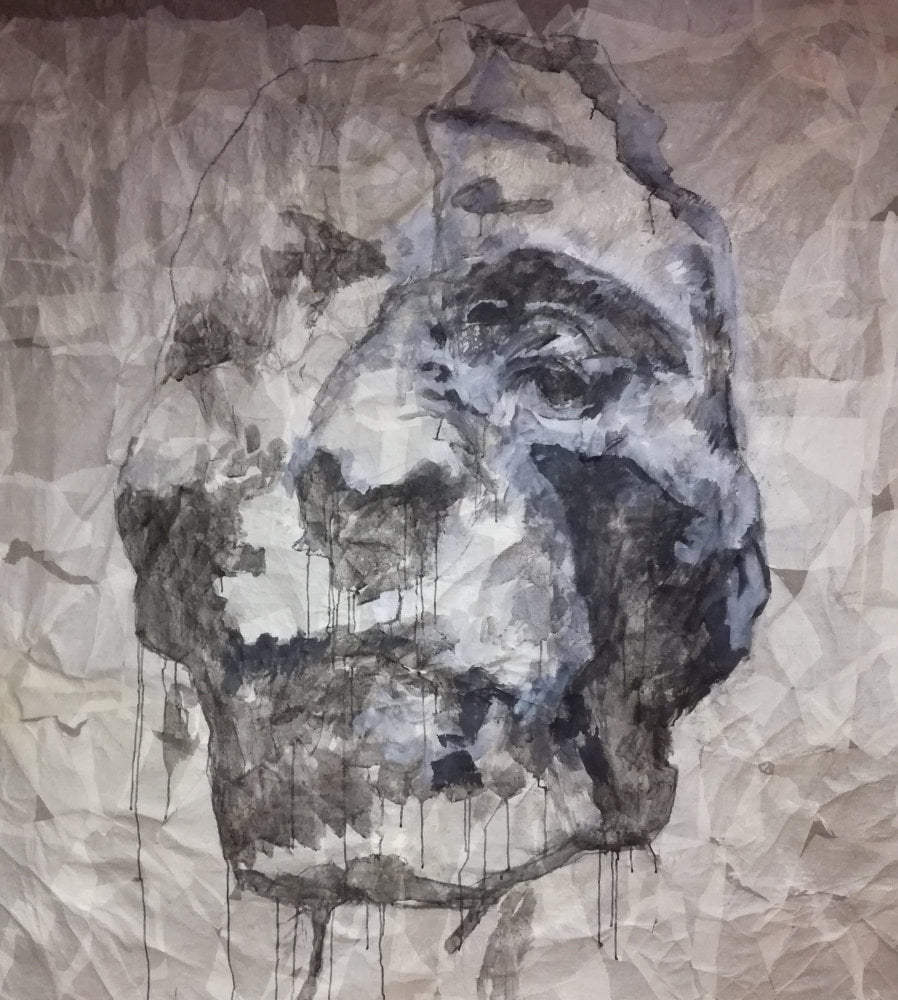
Elders 1, 180×180cm
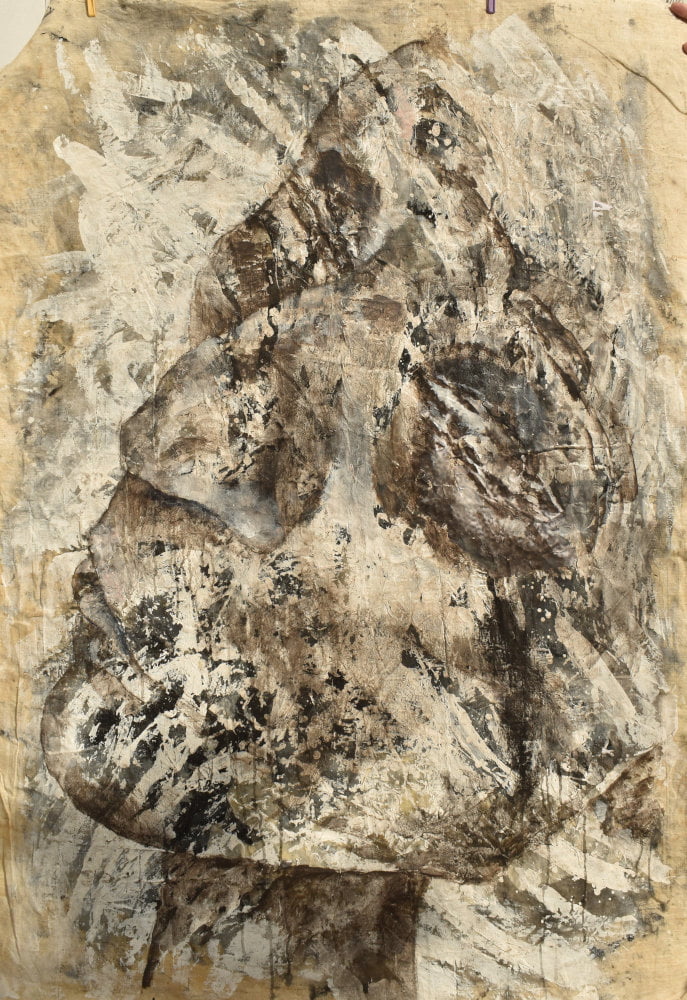
Elders 2, 110×150cm
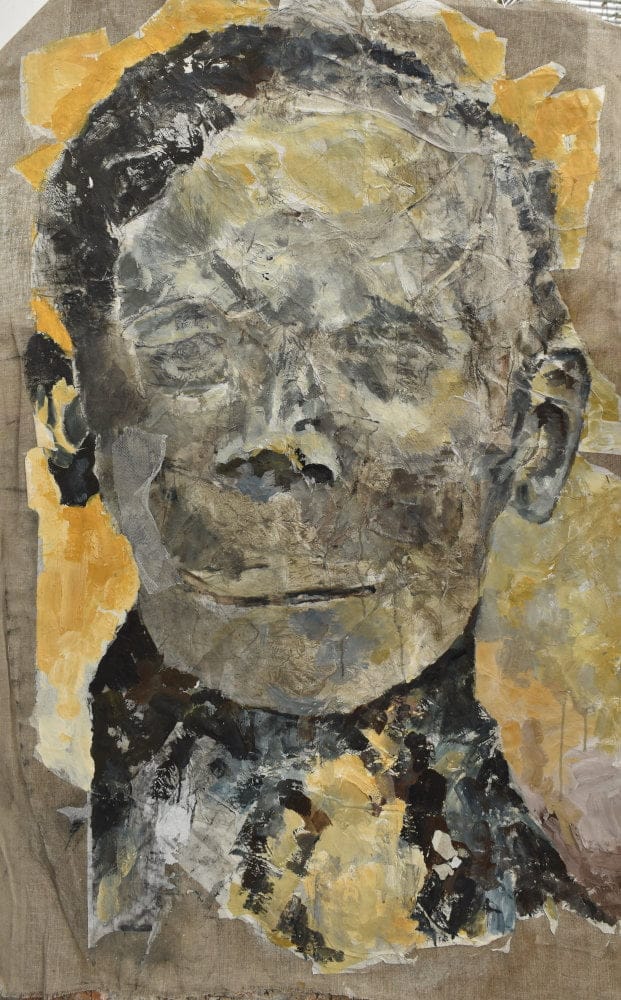
Elders 3, 120×145cm
Beasts stood
By the door,
Shot into them,
They died.
(A tiny boy’s verse.)
Arkady and Boris Strugatsky
“Beetle in the Anthill”
Hairy Fascists
Father had fascists with long hair… It was a puzzle to me because all the young people had long hair. But could they really be fascists? Especially since in movies, fascists didn’t have long hair. One day I realized that it was an image of the intelligentsia in the mind of a twisted, paranoid, cowardly warrior.
Imagination is one of the “most important anthropological foundations for the possibilities of social development inherent in human beings. The basis of science fiction is precisely imagination, fantasy. Science fiction literature, especially a genre like social-philosophical science fiction, “successfully introduces the thinking reader to the realm of common, most contemporary, deepest problems, things that fall out of the sight of other types of fiction – the place of a human being in the universe, the essence and possibilities of reason, the social and biological prospects of humanity, and so on.
Let’s agree with the opinion of the Strugatsky brothers, as the creators of social-philosophical science fiction attempt to solve problems primarily concerning Man.
“Understand, I don’t consider him my student! I can’t consider him! It’s my failure! My only failure! From the very first day and for ten years straight, I tried to establish contact with him, to extend even the thinnest thread between us. I thought about him ten times more than about any other of my students. I bent over backward, but everything, literally everything, I undertook turned into evil…”
Arkady and Boris Strugatsky
“Beetle in the Anthill”
All I remember is when I was an embryo.
When I was little… Perhaps I don’t remember anything, I only remember one thing: father seemed enormous, strong, frightening…
“A child cried. Somewhere far away, at the other end of the ship, behind many doors, a little child cried desperately, tearing himself apart and choking. A little, really little one. Maybe a year old. I slowly raised my hands and pressed my palms against my ears.”
Arkady and Boris Strugatsky
“Baby”
The science fiction writers spoke about the problems of contemporary man long before their emergence; they saw them in their infancy. One such problem is the invasion of the future into the present, an invasion driven by unprecedented rates of social and technological…
What can we say to those to whom we can never say anything?
My father lived in some distant, paranoid-fantastic world. In his real world, there were spies and traitors, marauding Cossacks and other ruffians. He was suspiciously cunning, gathering information about everyone and then making calls and writing reports while being extremely pleased with himself. Yet, he had no authority except for some friends in the intelligence agencies. Once, during the time I was studying at the institute, he reported me simply for listening to popular music…
“I don’t remember a single instance when he lied. Even in that age when children lie readily and senselessly, deriving pure and selfless pleasure from it. But he didn’t lie. And, moreover, he despised those who did. Even if they lied selflessly, out of curiosity. I suspect that there was a moment in his life when he first realized with horror and disgust that people are capable of telling lies.”
Arkady and Boris Strugatsky
“Beetle in the Anthill”
Three wise men sat in the shade of a large tree, enjoying their conversation. They argued about what is more important for a person – the past, the present, or the future. One of them said:
“My past makes me who I am. I know what I have learned in the past. I like people with whom I used to get along well or those who resemble them.”
“It’s impossible to agree with that,” said another. “A person is defined by their future. It doesn’t matter what I know and can do now – I will learn what I need for the future. My actions now depend not on who I used to be, but on who I intend to become. I like people who are different from those I knew before.”
“You completely overlook,” the third one intervened, “that the past and the future exist only in our minds. The past is gone. The future is yet to come, and regardless of whether you reminisce about the past or dream about the future, you act only in the present.”
Life in a Split World
I always believed my father, and it turned out that he was a hero. A titan who defeated the fascists who occupied our entire world. Once he told me how he participated in military actions, killing enemies left and right, especially brutally suppressing rebellions… Many years later, my mother revealed that they were simply dropped off at the airport and flew away after firing some shots into the air.
When I visited the Terror Museum in Budapest, I wrote a review in the guestbook, asking for forgiveness on behalf of my father…
Secret Services. Fear and Informers
When it came to mentioning any secret services where he had never worked, my father seemed mysteriously happy. His life became colorful and joyful, as if merging and blending into one. His split life turned into a cohesive, monolithic structure with stories of past heroes.
For a small number of people, a third signaling system activates within them. They move to a new evolutionary level, severing all previous connections with ordinary people, and when they gather and find each other, they depart from Earth to create a new civilization somewhere, incomprehensible to ordinary mortals.
When I Was Little, I Read the Strugatskys
Once, my mother took me from the hospital, and I stayed at home. I came across a science fiction book. It was the works of the Strugatsky brothers. My father didn’t pay attention to what I was reading. Apparently, he wasn’t interested in the future.
The essence of a person is the ability to adapt to everything. If humans didn’t have such patience and endurance, all good people would have perished
Addressing the Future
You, who have already died or been born to die, you who are rigid in your own world, you ancestors who are wiser and more enlightened than us, what can we learn if we cannot listen and create, what are we worth if we cannot speak of how we live, how you survived if you don’t teach us about truth, honesty, and nobility, what are you worth?
You did not have our technologies, but you knew what humanity is, sacrifice and life, because you are dead, and we are not yet.
“So, here I am to say,” Abalkin spoke in the same quiet, colorless voice, “that you have acted foolishly and vilely towards us. You have distorted my life and achieved nothing as a result. I am no longer on Earth, and I have no intention of leaving. Please be aware that I will no longer tolerate your supervision, and I will ruthlessly rid myself of it.
I stepped towards Abalkin and crouched beside him. (Excellency gave me a cautionary grunt.) Abalkin stared up at the ceiling with glassy eyes. His face was covered in long-standing gray patches, and his mouth was bloody. I touched his shoulder. The bloodied mouth moved, and he spoke:
“Beasts stood by the door…”
“Leva,” I called.
“Beasts stood by the door,” he repeated insistently. “Beasts stood…”
And then Maya Toivovna Glumova screamed.
Arkady and Boris Strugatsky
“Beetle in the Anthill”
The world cannot change forever, for nothing is eternal, even change… We do not know the laws of perfection, but perfection is achieved sooner or later. Look, for example, at how our society is structured. How pleasing to the eye is this clear, geometrically precise system! Peasants and craftsmen at the bottom, followed by the nobility, then the clergy, and finally the king. How everything is meticulously planned, what stability, what harmonious order! Why change anything in this honed crystal, fashioned by the hands of a celestial jeweler? There are no buildings more durable than a pyramid – any architect will tell you so.
The Diary
At the age of sixteen, I made the decision to start writing a diary. I even filled an entire notebook with accounts of my life. However, it wasn’t long before my father appeared before me, holding the notebook he had discovered while rummaging through my desk without my permission. He claimed that I had portrayed him and his esteemed figure incorrectly and emphasized the need for corrections… Since then, I have ceased keeping diaries, refrained from making any entries, and burned whatever I write. It seems that this is why I became an artist—because I felt repulsed when others read my words.
“It was a child, a boy of twelve, an angular adolescent with bony, long legs, sharp shoulders, and elbows. Yet, these were the only features that resembled an ordinary boy. His face was already devoid of boyishness, possessing human features but completely motionless, petrified, frozen like a mask. Only his eyes were alive, large and dark, darting left and right, as if peering through the slits of a mask. His ears were large, sticking out, with the right one noticeably bigger than the left, and beneath the left ear, a dark, uneven scar stretched down his neck to his collarbone—an unsightly, poorly healed scar. Matted reddish hair fell in disarrayed tufts onto his forehead and shoulders, sticking out in various directions, and a wild forelock jutted up on the crown of his head. It was a gruesome, unpleasant face, further accentuated by its cadaverous, bluish-green shade, gleaming as if smeared with some grease. Indeed, his entire body glistened in the same manner. He was completely naked, and as he approached the ship and dropped a bundle of twigs onto the sand, it became apparent how sinewy he was, devoid of any traces of that touching vulnerability of childhood. He was bony, yes, but not emaciated—astonishingly robust in an adult manner, not muscular, not an athlete, but precisely sturdy. Additionally, terrible ragged scars became visible—a deep scar on his left side running across his ribs to his thigh, which explained his lopsidedness, and another scar on his right leg, along with a deep indentation in the center of his chest. Yes, it was evident that life had not been easy for him here. The planet diligently chewed up and gnawed on this human cub, but apparently, it had finally molded him into conformity with itself.”
(Arkady and Boris Strugatsky, “The Infant”)